A Novel
Songing
A College Story
a novel by Edward Bablin
“I wake up in the morning with a song in my head, and I sing it daily.”
Paperback · 122 pages
What it’s about
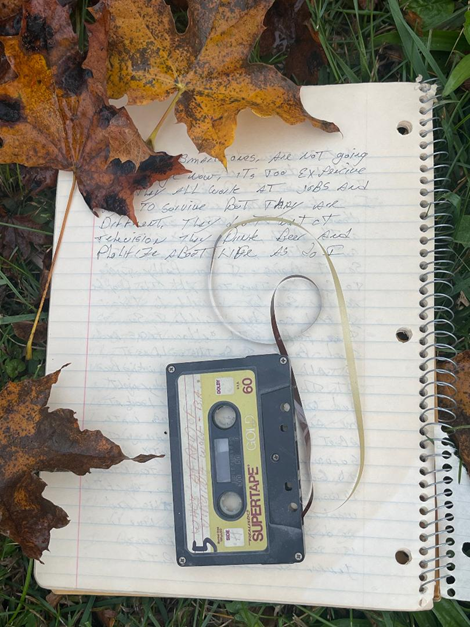
Assembled thirty-eight years later from eleven boxes left on a front lawn — letters, postcards, cassette tapes, spiral notebooks dense with maps of imaginary countries — this is Stan Strokolis’s account of a young man who refused to stop singing even when everything else stopped working. Through four years of academic catastrophe, a band that was going to save the world, a professor who betrayed his trust, and a cast of friends and almost-loves who orbit him like moons, Michael Bannister keeps going.
He always keeps going.
“You got stories to tell.”
For thirty-four years, the author worked as a home health aide. In the late 1990s, while caring for Bernard Vonnegut in hospice, he shared a cup of coffee with Bernard’s younger brother, Kurt. Kurt looked at him and said: “You got stories to tell.”
This is one of them.
Read the opening
There are those people who write novels in this world to become famous and make money, bestseller-list types who stalk the market and trend like wolves, noses twitching for the next fix of relevance, casting their prose as bait for film options. Their faces, you see, float on the backs of dust jackets in big-box bookstores, grinning through a veneer of mass-appeal, all flashbulb and advance checks. Some of them probably never even cared if the words themselves meant anything, so long as the words accumulated, like landfill, under their name. They chase the reader’s gaze as if it might transmute them into something more than a clever monkey in a blazer with a contract. They speak of “platform,” not legacy; of “audience,” not language. Fame, money, or at least a memorial plaque on the wall of a chain coffee shop in a suburb.
There are those people who write novels in the world because they’re notorious, or who seem to take a weird, unwholesome pleasure in the propagation of violence and mayhem. They’re not the same as the bestseller wolves, exactly — instead of hunting the herd, they want to scatter it, incite a stampede, let the bodies pile up and call it literature. They are the connoisseurs of infamy, the engineers of controversy — writing not so much to seduce the reader as to punch them in the face, leave a bruise, maybe even a permanent scar. They want to be infamous, and if it takes a little literary arson to get there, they’ll light the match, every time. There is a theory that these writers are acting out a larger social necrosis, the death wish of an empire in its decline, but I think it’s something simpler and sadder. They like to make trouble, and this is the only way left that’s legal.
Then there’s the third way. The third way is made up of people who never had any right to write a novel at all, at least according to the world. Not the trust fund Ivy kids or the wounded prodigies, but the ones who came to language late, sometimes backwards, sometimes sideways, sometimes as a byproduct of jobs, or illness, or the accidental slant of immigrant voices at the dinner table. They were born into the permanent backdraft of the American machine, churning out their years in check-out aisles, food courts, car washes, nursing homes, and high school kitchens — learning the shape of words only as a function of survival, not as a ladder to some cathedral of taste. They wrote because no one else was ever going to write about them, or for them. They wrote because the stories in their heads were the only inheritance they’d ever be allowed to keep.
You’d know them, if you met one, by the stains on their hands or the way their knuckles tell the history of hard jobs and self-repair. Their sentences might have strange gaps, like teeth knocked out in a bar fight, and their grammar might lurch or limp, but every line is a compulsion, a work-around for the way the world never gave them a straight shot. Who would listen? The answer: almost no one, until the day someone does, and then it gets out that the best stories come from the people with the least reason to tell them.
Now and then, one of these writers gets loose in the world and the world doesn’t know what to do except make it a novelty, an anomaly, a “voice from the margins.” But here’s the trick: their stories will outlive all the others, because they contain something the market can’t synthesize, and the controversy-mongers can’t fake — something like truth, or pain, or a sense of humor about the whole goddamn mess. It’s the third way, the unglamorous path, the slow leak of language from the bottom of the world. This story is written by one such person.
— E. Michael Bablin
Ready to read it?
Stay in touch
Get new writing from Edward Bablin delivered to your inbox.
